
Bathroom Renovation in Tallahassee: Who Does What
9 min read
A bathroom is the smallest room in the home with the most trades in it. Where the carpentry ends, where a licensed plumber begins, and why to find out early.
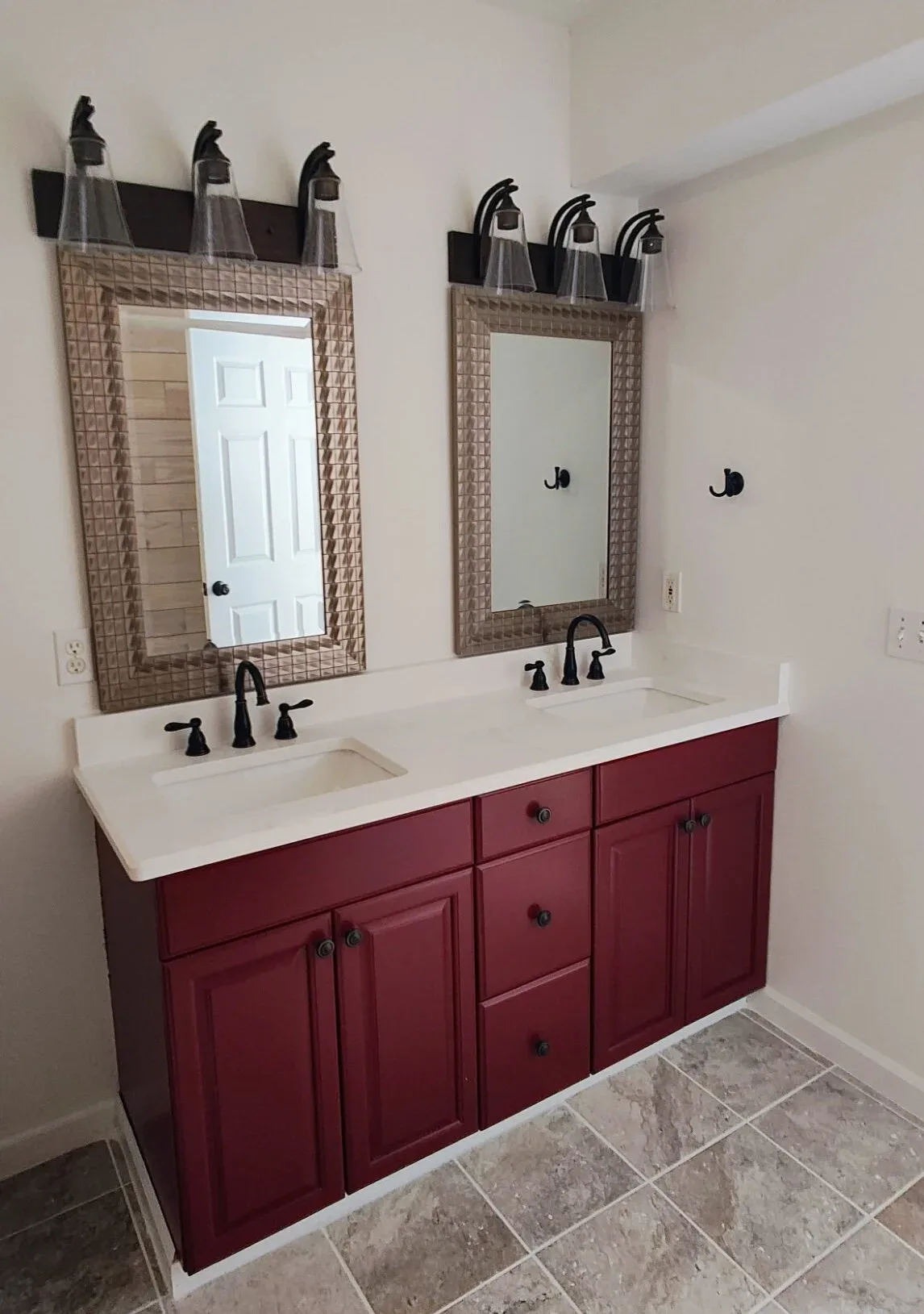
A well-planned bathroom renovation can turn one of the smallest rooms in your home into one of the most comfortable and useful, with a fresh vanity, new tile, better storage and trim that pulls it all together. It is also the room with the most trades packed into it. Into forty square feet go plumbing, electrical, tile, cabinetry, drywall and trim, and everything is looked at from two feet away.
So this guide starts with who does what, because that is what shapes how your project is planned, what it costs, and whether it runs to time. Sorting it out early is the difference between a renovation that runs smoothly and one that stalls partway through, and it is the easiest part to settle before the work begins.
Two kinds of bathroom project, and only one needs a plumber
Before anything else, work out which of these you are describing. They are priced differently, they are scheduled differently, and they need different people.
The in-place renovation. Everything stays where it is. The toilet, the tub or shower and the sink keep their positions, and what changes is what you see: a new vanity in the same footprint, new tile on the floor or up the walls, better storage, an accent wall, new trim, new doors. This is the more common of the two, and it is mostly carpentry and finish work.
The one that moves fixtures. The sink goes to a different wall. The tub comes out and a walk-in shower goes somewhere else. A new circuit is needed for heated flooring or a different lighting layout. The moment a project crosses that line it needs a licensed plumber or a licensed electrician, and that changes both the sequence and the budget.
The reason to sort this out on day one is that the two projects barely resemble each other. An in-place renovation can be scoped, priced and booked straight away. One that moves fixtures needs another trade lined up before we can give you a start date that means anything.
Where our work starts and where it stops
Kevin is a carpenter and the business is insured, so it is worth being plain about what falls on each side of that.
Ours: the vanity, the tile, the built-in shelving and storage, accent walls, the trim that ties the room together, the door, and any sheetrock that needs hanging, patching or finishing before paint. If you have bought a vanity yourself, we will fit it. If the room needs storage built to its actual dimensions rather than something bought to approximately fit, that is what custom cabinetry is for.
Not ours: plumbing and electrical. If your renovation needs major plumbing moved or major electrical changed, you need a licensed plumber or a licensed electrician for that part, and Kevin will tell you so before you plan around us. We do not subcontract it, because we cannot.
Telling you this early is exactly the point. If you know at the start that the sink relocation needs a plumber, we can plan the whole job around it. If it only comes up midway, the room sits unusable while another trade is found. Kevin will flag it at the estimate, so it is never a surprise.
Everything here is looked at from two feet away
Tolerances in a bathroom are tighter than anywhere else in a home, and the reason is simply how close you stand to things.
A vanity a quarter of an inch out of level reads immediately, because there is a countertop and a mirror above it giving your eye two horizontal lines to compare. In a bedroom you would never notice the same error. Tile is less forgiving still: it will not hide a floor that was not flat before it went down, and any unevenness shows. Lippage, the tiny height difference between one tile edge and the next, catches the light in a small room in a way it never does in a hallway.
This is why prep takes longer than people expect and why it is the wrong place to save money. Getting the floor flat and the walls plumb before anything decorative happens is most of the job. The tile is the easy part once the surface underneath it is right.
The same logic applies to the trim and the door casing. In a room this size, a miter that is slightly open is at eye level and eighteen inches from your face while you brush your teeth. Old homes in the Tallahassee historic districts are rarely square anywhere, and a bathroom is where that stops being a technicality.
What the climate does to a bathroom
A bathroom is a humid room in a humid state, and that combination is harder on materials than anything else in the home.
Particleboard is the material that suffers first. A vanity with a particleboard box, sitting on a floor that occasionally gets wet in a room that reaches high humidity twice a day, will swell at the base and not recover. Plywood or solid stock costs a little more up front, and it is the difference between a vanity that lasts and one you replace.
Ventilation matters more here than it does in most climates, and it is worth checking that whatever extraction the room has actually works before you spend on finishes. A room that does not dry properly between showers will find the weakest material in it, whatever that happens to be.
Paint is the third. In this climate, a wall that was not properly prepped will start to show it within two years, and in a bathroom it happens sooner. Most of a good paint job is in the preparation, and the painting itself is the quick part at the end.
Why the Surface Behind the Tile Matters
A tile job lasts because of what is underneath it. Beautiful tile set over a substrate that was not prepared right will not hold up, however good it looks on the first day.
Tile is only ever as good as what it is stuck to. If the surface behind it is not flat, the tile will show it. If the surface is not sound, the tile comes loose eventually no matter how good the adhesive was. Water that gets past a grout line and finds ordinary drywall will do quiet damage for a long time before anything appears on the surface, which is exactly why the damage is usually extensive by the time somebody calls.
If you are renovating a bathroom that has had a leak, or one where the tile is coming away, expect the honest answer to involve taking more off than you hoped. That is also the moment our change order process matters: the possibility of finding something is disclosed on the estimate you sign before anything starts, so if the wall behind the tile turns out to be worse than it looked, the work stops, Kevin shows you what is there and talks through the options, and nothing goes ahead until you have approved it.
Storage Makes the Biggest Daily Difference
The part people tend to be gladdest about later is rarely the tile. It is having a proper place to put everything.
A bathroom with only a vanity pushes everything onto the countertop, which makes a small room feel smaller. Built-in storage is one of the smaller lines in the room and one you use every day, a run of shelving in an alcove, a tall unit in the dead space beside the door, drawers instead of a cabinet so you can see what is at the back.
This is also where building to fit pays off, because bathrooms are full of odd dimensions: the gap beside a toilet, the space under a sloped ceiling, the eight inches between a doorway and a corner. Nothing off a shelf fits those spaces, but something built for them fits exactly.
The order it actually happens in
Getting the sequence right is most of what keeps a bathroom project on track, so it is worth seeing it laid out.
Any plumbing or electrical that is moving goes first, and it is done by a licensed plumber or a licensed electrician. Then the substrate: sheetrock hung or patched, walls made plumb, the floor made flat. Then tile. Then the vanity, set level and scribed to the wall. Then storage and built-ins. Then trim and the door. Then paint.
Nothing in that list can jump the queue without causing rework. Tile before the walls are right means the tile comes off again. A vanity before the floor is level means shimming a cabinet to hide a problem that should have been fixed underneath it.
Talking to us about a bathroom
The most useful thing you can tell us on the first call is whether anything is moving. Sink to a different wall, tub out and shower in, new lighting layout. If the answer is no, we can scope the whole thing ourselves. If the answer is yes, we will tell you which trade you need and when, and plan our part around theirs.
Kevin comes out and looks at the room with you rather than pricing it over the phone. He works out the materials and the labor afterwards and sends you a detailed estimate, which is based on what is actually in the room instead of on a guess. It is free and there is no obligation.
The work is done by Kevin and Lil Kevin, the same two people from the first day to the last, and the workmanship carries a warranty. Call Amanda and she will get it booked.
Want this done at your place?
Reading about it only gets you so far. Kevin will come out, look at the actual room, and tell you what it takes. The estimate is free.
Written for homes around here
Everything above is aimed at homes in Tallahassee and the Big Bend. The humidity, the tree canopy and the age of the housing stock all change the answer, and this is written from what we actually see on jobs rather than from a national template.
Related Services
Talk it through before you start
Kevin comes out and looks at the job with you, then sends a detailed estimate once he has priced it. Free estimate. Insured. Workmanship warranty on every project.